
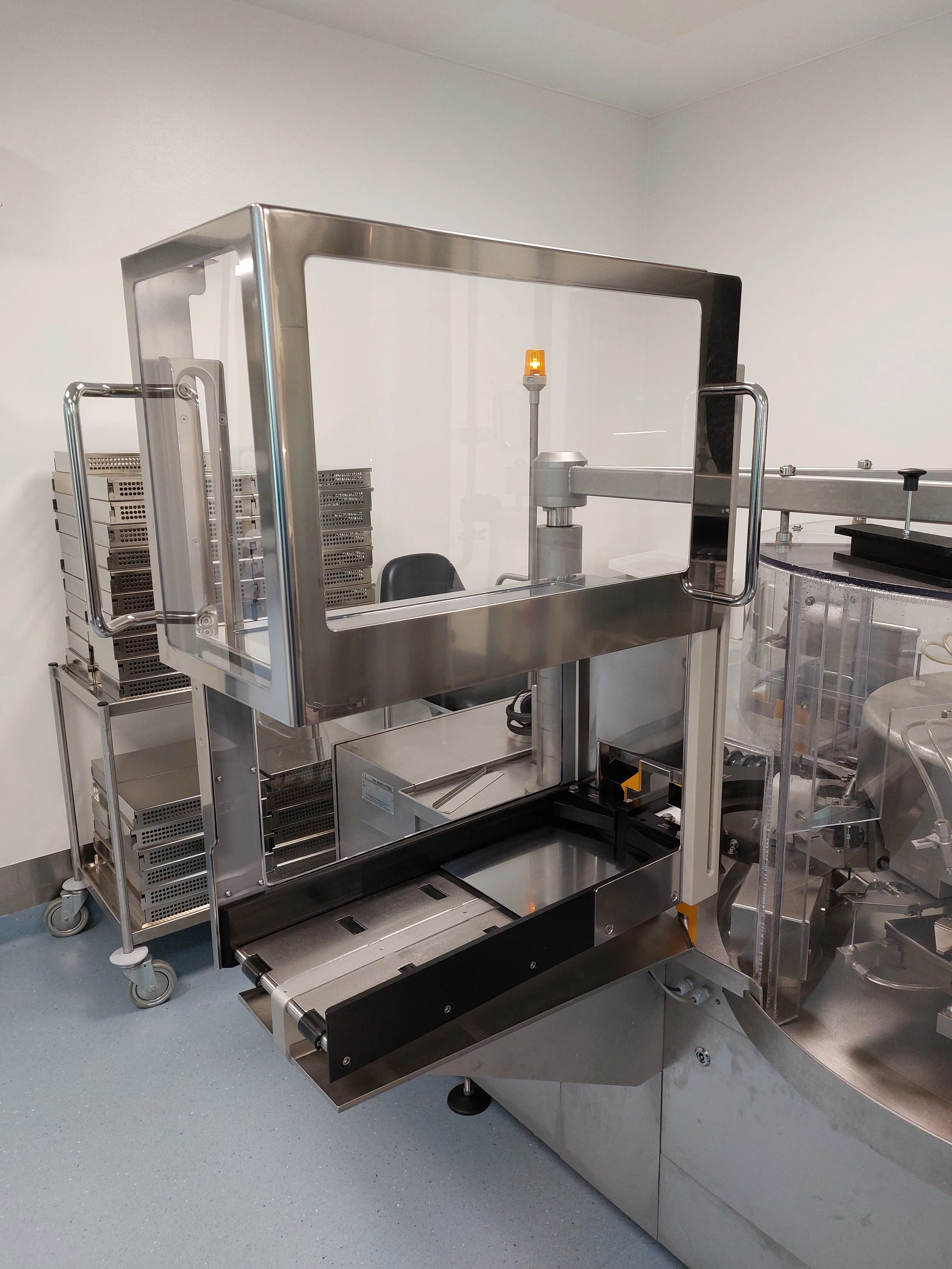
Enclosing the final chute on a pharmaceutical filling line – from initial need, to sketch and documentation of the final product
How do you protect freshly filled vials from airborne contamination – without making the operator’s job harder? That was the challenge when a pharmaceutical manufacturer asked Soltech to enclose the final chute on an aseptic filling line.
At the end of the line, small vials of finished pharmaceutical product run down a chute and are collected in a basket for the next process step. The chute was open to the cleanroom. Even in a controlled environment, there is a theoretical risk that particles from the room air or from the operator could settle on the vials. To meet modern requirements for aseptic production, the chute had to be enclosed – both above and around it.
It sounds simple, but the task came with three requirements that pull in different directions:
Full shielding of the vials from the room air.
A door the operator can open easily during daily operation.
No air turbulence when the door opens – it must not draw room air in over the open vials.
On top of that, everything had to be made from cleanroom-approved materials and be as aseptic as possible. In this post, we follow the project from the first sketches to the finished documentation package.
1. Ideas and sketches: understanding first, solutions second
We didn’t start at the drawing board – we started at the line. Together with the customer’s process owners and operators, we walked through how the vials move down the chute, how baskets are changed, and where the operator stands and reaches in.
That knowledge became the first hand sketches. Here we explored several principles for the door – how it can open, and which way the air moves when it does. The key insight was that the movement of the door itself is the biggest source of turbulence. A door that swings open like a regular door acts as a pump and pulls air in behind it.
The sketches were reviewed with the customer before we chose a concept. That way, the users’ experience shaped the decision before any time was spent on detailed design.
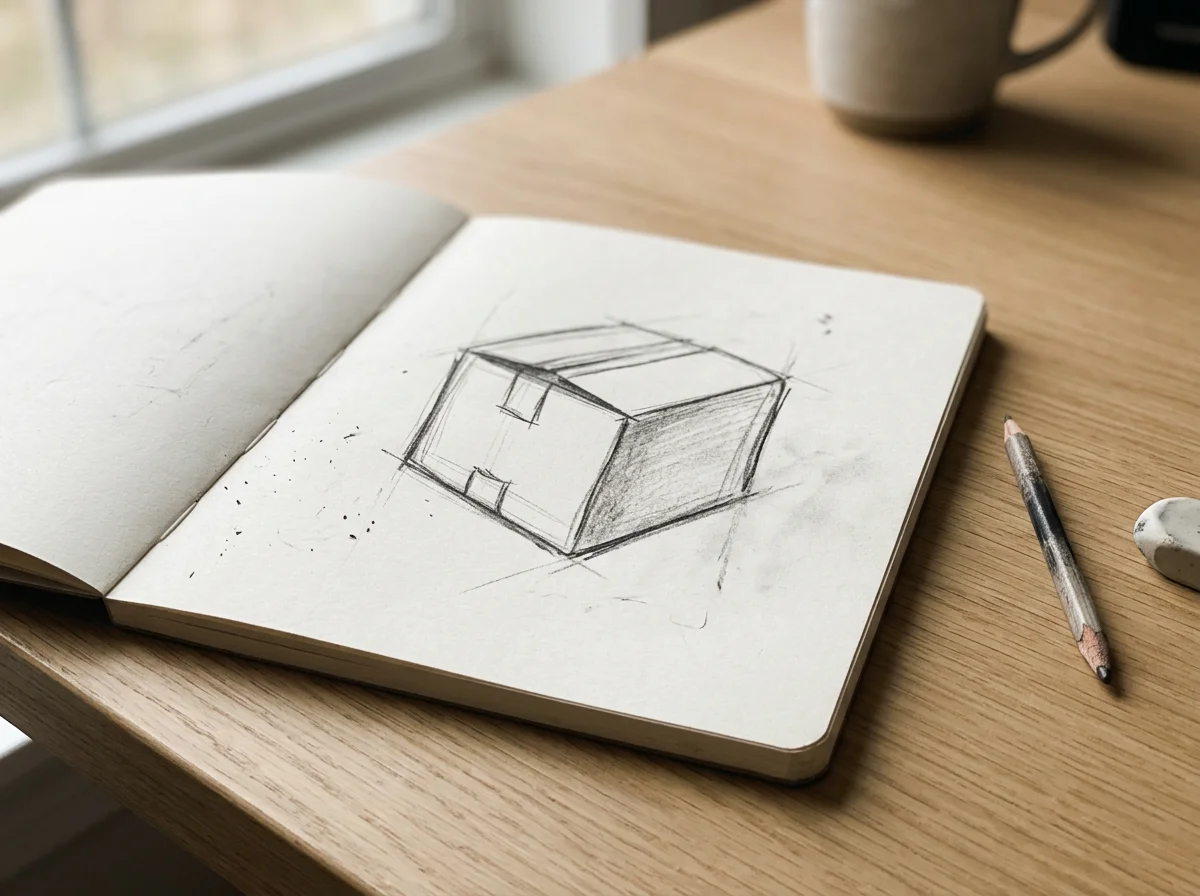
Hand sketch of door concept
2. Design: from concept to 3D model
The chosen concept was built up in CAD. The 3D model let us position the enclosure precisely in relation to the existing line, check clearances for vials and baskets, and show the customer the solution before any material was cut.
The design balanced four considerations:
Aseptic geometry: smooth surfaces, rounded corners and as few joints and gaps as possible, so there is nowhere for particles to collect and cleaning is simple.
Cleanroom-approved materials: every part is chosen to withstand the cleanroom’s cleaning agents and disinfectants without shedding particles. [Acid resistant stainless steel (316L / 1.4404), Peek, and PETg]
Door movement: the door is designed to open without pushing or drawing air in over the vials. [The door simply slides up and down, in the open position (up) it can be slided sideways and lock in that position]
Ergonomics: the door slides up and down, so as a safety measure it requires the operator to use both hands. This removes the risk of the door dropping from an accidental push, while the operator keeps a clear view of the vials.
Render of CAD-model
3. Manufacturing: clean from the first part
Once the design was approved, we moved into production. For a cleanroom product, manufacturing is part of the quality – not just craftsmanship. Every part was made to the approved 2D drawings, and all surfaces were treated to be smooth, easy to clean and durable.
Every manufacturing step was chosen to keep surface roughness as low as possible and leave as few places as possible where dirt and particles can collect:
Stainless steel sheet parts are made from sheet with a 2B surface finish, laser welded and then electropolished.
PEEK parts are machined and then wet-sanded and polished.
Joints between steel and PETG are sealed. The PETG panels are transparent so the operator can see into the enclosure.
Before delivery, the parts were cleaned, inspected and packed so they could go straight into the cleanroom. Installation on the line was planned with the customer to keep disruption to production to a minimum.
Finished enclosure installed on the line
Close dialogue throughout the project
A common thread through the project was close contact between the customer, the operators and our development team. Each phase ended with a review where the customer approved the direction before we moved on:
Sketches and concepts were evaluated together with the operators.
The CAD model was reviewed and approved before materials were ordered.
Manufacturing and installation were planned around the customer’s production schedule.
Working this way means no surprises at the end. The people who use the solution every day helped shape it.
4. Documentation: full traceability
In the pharmaceutical industry, a product isn’t finished until it’s documented. The enclosure was therefore delivered with a complete documentation package that supports the customer’s qualification and validation:
| Document | What it ensures |
|---|---|
| Material certificates | Every material can be traced back to supplier and batch |
| 2D drawings | Exact description of all parts and dimensions, for inspection and future spare parts |
| Surface treatment certificates | Proof that surfaces meet the specified requirements |
| Traceability | A clear link between drawing, material and finished part |
The documentation makes it easy for the customer to approve the equipment internally and with the authorities – and to maintain it for years to come.
The result
The filling line now has an enclosed final chute that protects the vials from airborne contamination without getting in the operator’s way. The door is designed to open without moving air in over the product, and the entire solution is made from cleanroom-approved materials with full documentation.
The project shows how Soltech works: we start with the users, work out the details together with the customer, and deliver a product that is ready for a regulated environment.
Facing a similar challenge in a cleanroom or on a production line? Get in touch – we’d be happy to talk about how we can help.